ENTERPRISE INTEGRATION - iPaaS
Connect Your Systems.
Stop Rebuilding the Same Integrations.
Karolium helps to connect your core systems without building custom code for every edge case. It acts as the central integration layer across your ERPs, supply chain software, legacy databases, partner feeds and custom. Instead of writing point-to-point scripts, your team configures integrations once, validates incoming payloads on the fly, and keeps data moving in both directions.
The Modern Integration Trap
Every New Application Adds Another Direct Wire to Maintain
Every enterprise IT environment ends up with a mix of tools that were never meant to talk to each other. An on-prem ERP handles financials, a separate WMS runs the floor, a cloud CRM tracks customers, and dozens of trading partners send files over SFTP.
Mismatched Data Models
Your ERP, CRM, and warehouse tools often disagree on basic operational definitions. A customer ID or SKU variation shouldn't require manual human reconciliation every morning.
Troubleshooting is pure guesswork
When an API format changes or a remote server times out, payloads drop quietly into the dark. Teams only find out when an order doesn't ship or an invoice gets lost.
The "Integration Black Box"
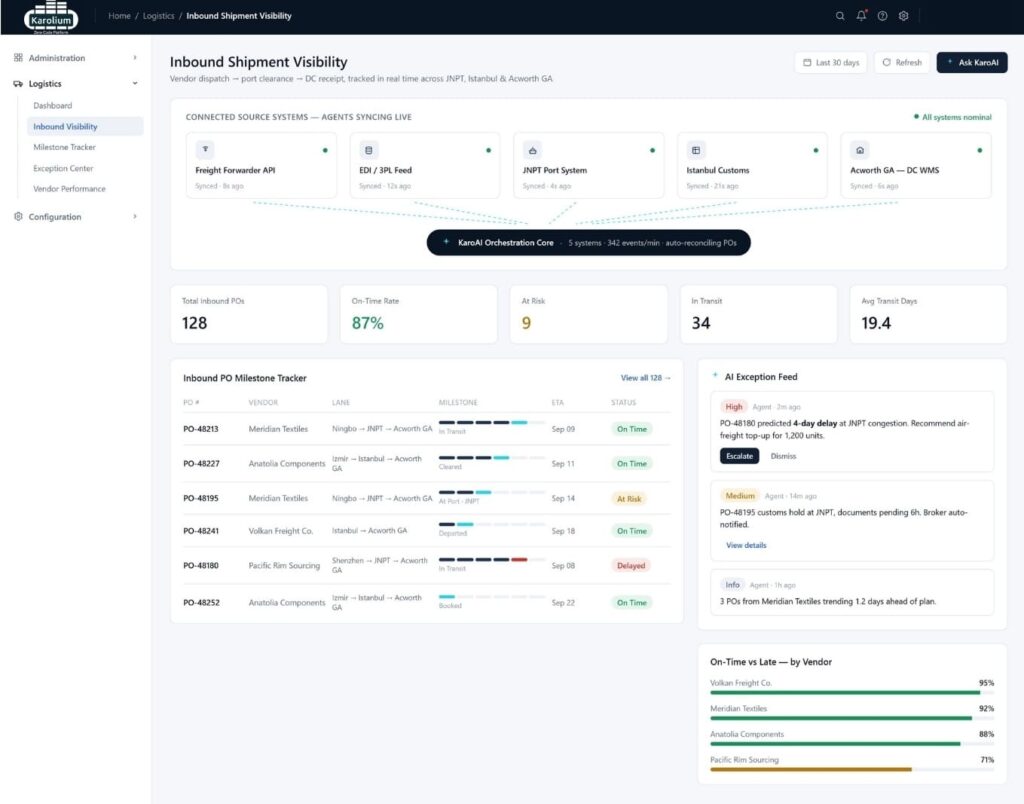
Standard data pipelines shuffle records back and forth, but they don't understand the operational context behind the data. If a record has an issue, developers have to dig through raw logs just to figure out what went wrong.
Maintenance burns your best developers
Every custom cron job, webhook listener, and one-off Python script requires ongoing attention. When an API changes or an endpoint goes down, an engineer has to drop what they’re doing to fix it.
Moving data isn’t the same as finishing the job:
Shuffling a raw record from an ERP to a warehouse tool doesn't resolve the order. If an item is out of stock or requires credit approval, a simple data pipe can't route the decision - leaving business processes stalled mid-stream.
What Karolium Integration Does
A Governed Layer Between Your Applications and Daily Operations
Rather than simply moving data, Karolium sits between your applications to manage how data enters, gets cleaned up, and lands in target systems that helps converting every integration into a meaning business outcomes. It handles the heavy lifting of enterprise plumbing: protocol conversion, field transformation, authentication, rate limits, and failure handling.
You don’t need to spin up separate tools for API management, file-based batch jobs, and schema validation. It’s all handled in one place.
For Business Stakeholders
- Keep your legacy systems working: You don't have to rip out stable legacy platforms just to bring in modern cloud tools. Karolium bridges the gap.
- Stop paying people to retype data: Eliminate the routine where staff pull spreadsheets out of one system, tweak columns, and upload them somewhere else.
- Launch new tools faster: Bringing on a new 3PL, vendor, or customer portal takes days of configuration instead of months of custom development.
- Cleaner operational numbers: When systems share standardized records, your reporting reflects actual inventory, orders, and balances.
For IT & Integration Teams
- Configure instead of code: Set up field mappings, routing rules, and transformation logic through an interface instead of writing boilerplate adapter code.
- Build a library of reusable endpoints: Define system connections and auth credentials once. Reuse those endpoints across as many incoming or outgoing pipelines as you need.
- Isolate failures so batches don't die: When a payload fails schema validation, Karolium catches the bad record, sets it aside, and alerts you. The rest of your data keeps moving.
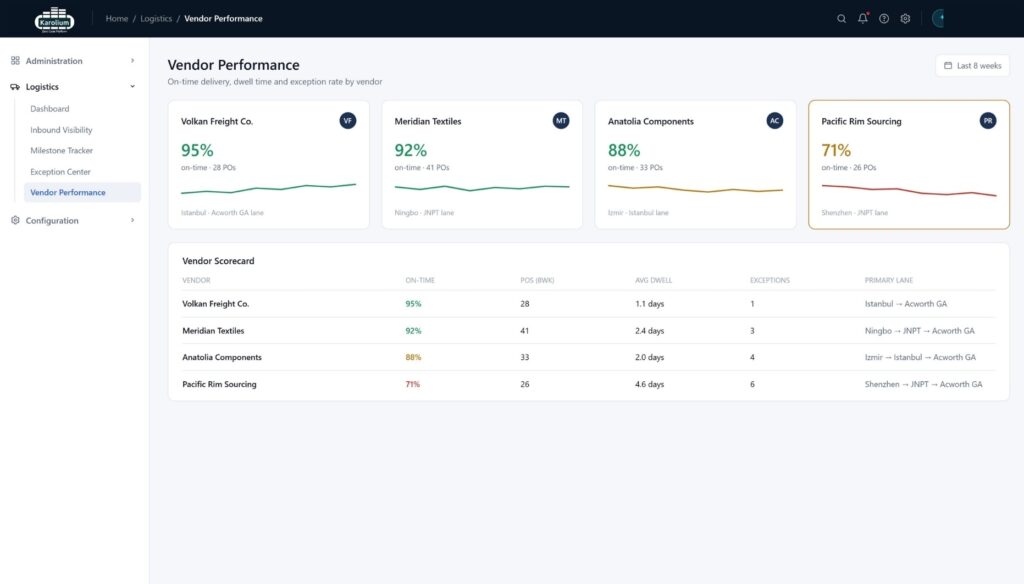
- Audit everything from one dashboard: View payload history, latency, delivery status, and retry queues without jumping across server logs and terminal windows.
Execution Path
From Ingestion to Delivery in Four Concrete Steps
Ingestion
Validation & Cleanup
Routing
Delivery & Audit
Karolium accepts data through inbound REST and SOAP APIs, incoming webhooks, database listeners, or scheduled SFTP/flat-file pickups.
The engine checks incoming payloads against your schema requirements. It cleans up formatting, maps custom fields to target definitions, and enriches records using internal lookup tables.
Depending on the data type and payload contents, Karolium routes the record to the correct destination systems, either in real time or via batch queues.
The payload writes to the target system. Karolium logs the round-trip response and records the transaction in an immutable audit trail. If the target system rejects it, the payload routes to an exception queue for easy inspection and replay.
Features
Key Features of Karolium Enterprise Integration
Bidirectional Endpoints
Inbound & outbound API control
Zero-Code Schema Mapping
Visual payload normalization
Event & Batch Sync
Real-time hooks + scheduled cron runs
Isolated Dead-Letter Queues
Automatic retries & failure isolation
Enterprise Protocol Adapters
REST, SOAP, SFTP, EDI, AS/400
Core Capabilities
The Plumbing You Need to Connect Complex IT Environments
Bidirectional API Management
Run both sides of the interface. Expose secure endpoints for third parties to send data in, or configure Karolium to call external APIs, query relational databases, and pull records on demand.
Visual Field Mapping & Data Translation
Convert complex JSON structures, XML trees, EDI documents, and delimited files without manual scripting. Set up value cross-references, text formatting, conditional logic, and math functions directly in the UI.
Real-Time Webhooks and Scheduled Batches
Run event-driven updates the second a database changes or a partner sends a webhook. For bulk reporting or legacy feeds, schedule hourly, daily, or custom cron runs.
Out-of-the-Box Error Handling & Retries
Stop debugging flat text files. If an endpoint is temporarily unreachable, Karolium pauses, applies backoff retries, and stores unwritten payloads in a dead-letter queue so nothing is lost.
Centralized Security and Access Controls
Store all endpoint tokens, SSH keys, and basic auth credentials inside an encrypted credential vault. Set role-based permissions so developers, admins, and support teams only access the connections they manage.
Measurable Relief for Your Technical Team and Operations
Cut Integration Delivery Cycles
Teams set up and verify new integrations in days rather than spending a quarter on development.
Fewer support tickets
Cleaner schema enforcement at the perimeter prevents bad data from corrupting core operational databases.
Lower maintenance overhead
Ensure your inventory, financials, and customer master records match across every system without human audits.
Confidence during system changes
Replace, upgrade, or add enterprise platforms without having to rewire your entire existing technology landscape.
Ready to Clean up Your Integration Architecture?
Stop spending engineering hours maintaining brittle connection scripts. See how Karolium gives you complete control over your enterprise data flow.