THOUGHT LEADERSHIP
What is your Offset Strategy?
Human beings are programmed to react as per the risk level. That is SENSE – SHIFT – STEER.
EXECUTIVE SUMMARY
The natural response of businesses during disruption is to follow the same path.
“SENSE THE ISSUE – SHIFT THE THINKING – STEER THE RESOURCES”. If they sensed the issue, they would have avoided or steered the favorable outcome in the first place.
Traditional software does not meet this human psychology or support this behaviorism.
Traditional software is built for a defined set of inputs and outputs with the definition of designing, implementing, and deploying ONCE.
On top of that, safeguarded under the Intellectual Property and Proprietary lens, it prohibits enterprises from customizing or extending the pointed and packaged solutions to their business variability.
Higher consulting rates, development costs, deployment timeframe, and the constant need for continuous upgrades have hindered innovation severely.
Cloud Adoption made it worse. So what is the offset strategy here?
An APPLICATION COMPOSITION PLATFORM, aka a NO-CODE PLATFORM .
An Application Composition Platform Is the Software That Makes Other Software Applications.
THE FOUNDATION
Are all platforms that are configurable considered NO-CODE?
Let’s deep dive here:
Website Builders
There are platforms that allow anyone (with or without a development background) to configure and launch websites (WordPress, Divi, Beavor, Elementor etc.). They have assets that accommodate websites with capabilities and limitations. However, we cannot use those platforms to build a banking software.
CRM Platforms
There are platforms that allow anyone (with or without a development background) to configure and launch a CRM (HubSpot, SalesForce). They have predefined assets that accommodate prospects’ data model, track opportunities, and customize the presales and sales process per the internal sales life cycle process. However, we cannot use that platform to build an insurance software.
IT Applications
There are platforms to enable IT team to build adhoc solutions and internal business process managements. but they lack to solve the complex problems as they are reserved for the best of the breeds.
Supply Chain Applications
Enterprise Supply chain operations are typically managed by COTS solutions (vendor application – OnPrem & SaaS) They focus by industry and business verticals with predefined assets that can define the customers’ SCM data(by retail or manufacturing) with the assumption that enterprises must adapt to software’s predefined workflows. As a result, users must adjust their standard operating procedures (SOP) with the application flow. The downside is, these COTS suites are not designed for ad-hoc supply chain disruption use cases that are not in the premise of their product scope.
FINANCIAL IMPACT
Myth Buster
Hardcoded Traditional Platforms
- Involve Configuration as part of the implementation phase – it doesn’t qualify them as NO-CODE PLATFORM
- Enable business users to set the master data and transaction workflows – it doesn’t qualify them as NO-CODE PLATFORM
- Facilitate users to customize the screens – it doesn’t qualify them as NO-CODE PLATFORM
- Leverage microservices and APIs to interact between components – it doesn’t qualify them as NO-CODE PLATFORM
NO–CODE PLATFORM SHOULD ADAPT TO BUSINESS PROCESSES, NOT THE OTHER WAY
Historical precedent suggests 15–25% annual share loss to disruptive, technology-enabled competitors — compounded by margin compression and a widening talent gap. Mitigation requires proactive investment before competitive threats fully materialize.
What is NO-CODE?
- Ideate a Business Case
- Ideate How the Solution Should Work (Process Flow – Screens – Data Model – Validation – Business Logic)
- Compose Solution using No-Code Platform Assets
- Orchestrate using APIs or built-in assets
- Extend or Recompose the Solution
- Repurpose same assets for ‘n’ number of Business Cases
- Go-Live without deployments
NOT So NO-CODE?
- Prerequisites and Hard Boundaries on What is Configurable vs Non-Configurable
- The Final Solution has rigidity in the Screens or Data Model or Validation or Logic or Execution of the Sequence
- APIs to orchestrate a solution Configured Solution needs redeployment
- NOT Future Proof: Configured Solution made in one release has to be ported to future base releases
- Components and Assets are INDUSTRY or DOMAIN or PRODUCT or MODULE Specific
CONCLUSION
Karolium Definition of No-Code Application Platforms
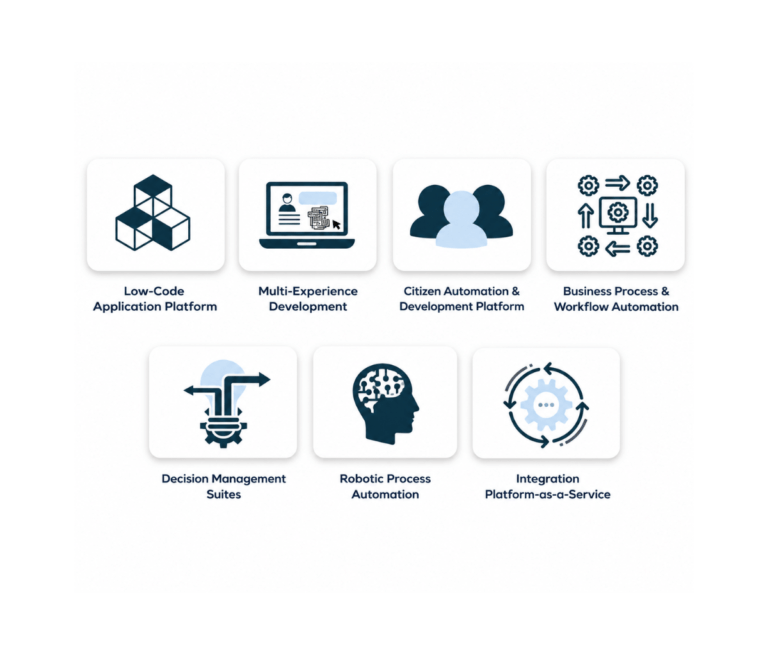
“A no-code application platform is a 100% composition platform that aids in composing front end, back end, and an integration layer of the software applications without prerequisites and boundary conditions. It is vendor, technology, product, and Module agnostic. It adapts to each enterprise’s business process including Data Model, Process Flow, Business Logic, Validation, Orchestrations, and enables users through Responsive User Interface.” In short, a piece of software that enables business users to create another software application without any rigidity is the true NO-CODE.